


What is customer satisfaction in a call center?Call center customer satisfaction is a measure of how happy customers are with a company’s support service. It shows how satisfied customers feel after interacting with a call center, making it a key indicator of the health and success of a company. |
Making customers happy and building long-lasting relationships goes far beyond having a good product or providing quality service. Customer satisfaction is also tied to how effectively you support customers when they face issues like products malfunctioning or services falling short of expectations. This means that call center customer satisfaction is a key indicator of the health and success of a company.
Call center customer satisfaction is a measure of how happy customers are with a company’s support service.When facing issues, customers want them to be sorted quickly. They also want to be treated with the friendliness and empathy they deserve. After all, the product or service shouldn’t be problematic in the first place.
But when problems arise, companies have the opportunity to shine and prove to the customer that they made the right choice. By offering efficient support, they can turn frustration into loyalty. This makes clients stay, share positive feedback about your brand, and even attract new loyal customers.
In contrast, bad customer service will result in a one-time purchase. At the end of the day, customers come to you looking for solutions, not problems.
So, the way to increase call center customer satisfaction is delivering easy, reliable, and empathetic support. There are plenty of ways to make this happen. 17, to be exact.
Let’s explore them one by one.
More in this guide:
- Why call center customer satisfaction matters
- What does CSAT mean in a call center?
- Best ways to measure call center customer satisfaction
- How to calculate call center CSAT
- What is a good CSAT score?
- 17 ways to increase call center customer satisfaction
- 4 common challenges in improving call center CSAT
- Customer story
- Increase call center customer satisfaction with Zendesk
Why call center customer satisfaction matters
Measuring customer satisfaction in a call center is essential to assess agent performance, resolution quality, and overall customer experience. Call center customer satisfaction matters to businesses because it’s the most important metric for measuring how well your call center meets customer expectations.
What does CSAT mean in a call center?
Short for customer satisfaction, CSAT in a call center is a measurement of how pleased your customers are with the service experience they received. The most important metrics in a call center CSAT context are:
Resolution speed
Resolution effectiveness
Response time
Interaction easiness
Agent professionalism
Agent friendliness
Overall, CSAT is a measurement of how happy and satisfied customers feel after interacting with your call center.
Best ways to measure call center customer satisfaction
The CSAT score is the percentage of customers rating their experience as satisfactory or better. To measure call center customer satisfaction, first you need to find the number of satisfied or very satisfied customers. To do this, send surveys with customer satisfaction questions after service interactions.
In your survey, use the Likert scale, a 5 or 10-point scoring rating system to measure customer sentiment.
Response | 5-point scoring | 10-point scoring |
Very satisfied | 5 | 9–10 |
Satisfied | 4 | 7–8 |
Neutral | 3 | 5–6 |
Dissatisfied | 2 | 3–4 |
Very dissatisfied | 1 | 1–2 |
You need the “satisfied” and “very satisfied” (rated 4 or 5) results to calculate your call center CSAT.
How to calculate call center CSAT
This is the basic formula to calculate call center CSAT:
Number of satisfied or very satisfied customers ÷ Total survey responses × 100 = CSAT
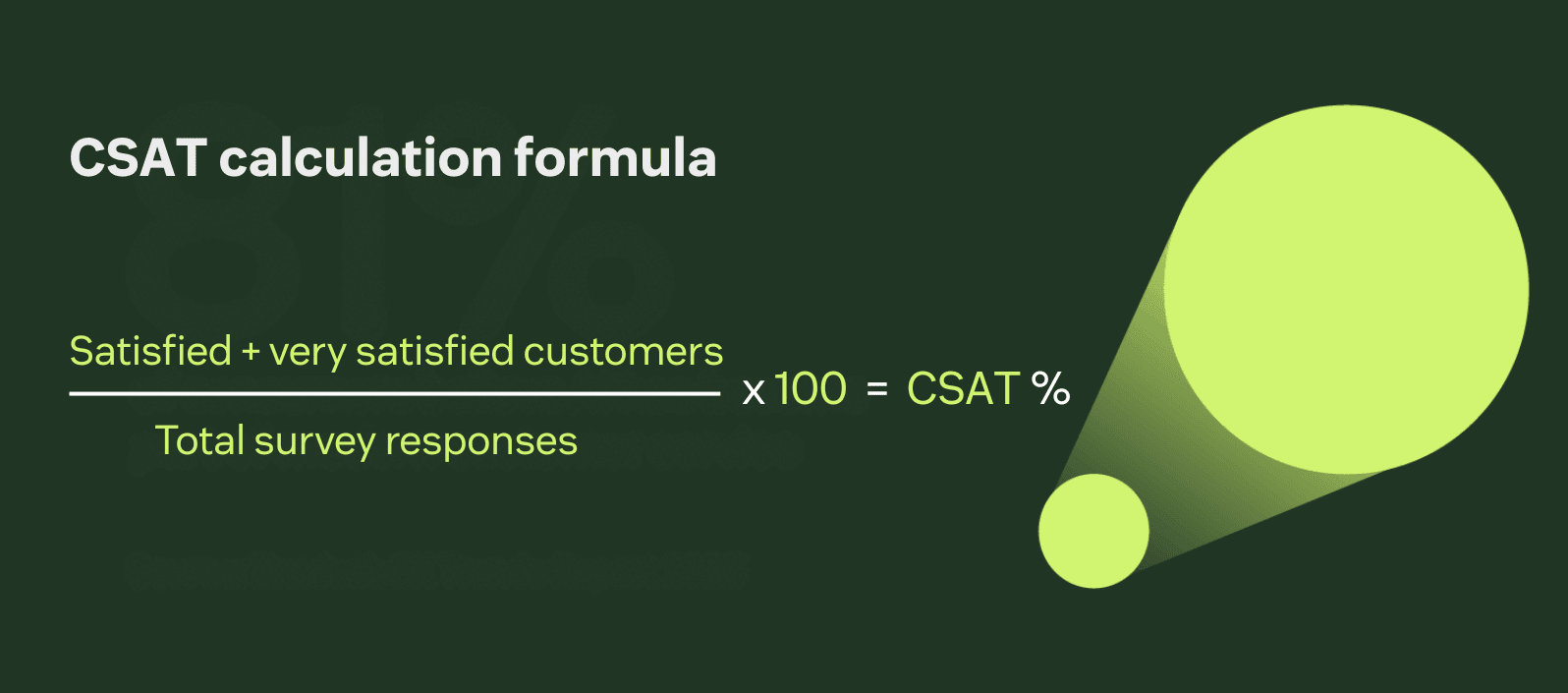
To illustrate, let’s say your survey results show that 100 customers are satisfied and 80 are very satisfied out of 200 responses.
So, your CSAT would be:
(180 ÷ 200) × 100 = 90%
This means your call center’s CSAT score is 90%, indicating that most customers are happy with their overall service experience.
You can also use a calculator, like this one.
CSAT calculator
CSAT score: 0%
Customers surveyed: 0
What is a good CSAT score?
A CSAT score between 75% and 85% is considered good in most industries, while a score above 90% means your customers are very satisfied and trust your brand. Of course, what counts as “good” can vary depending on your industry or company’s expectations and goals.
What really matters is steady improvement. When you see your CSAT score increasing, it means you’re on the right track. Keep that momentum going by setting clear benchmarks and checking your progress regularly.
17 ways to increase call center customer satisfaction
Improving call center customer satisfaction is about better communication, smarter use of technology, and reduced wait times. Here are 17 ways to increase call center customer satisfaction and keep your customers coming back.
Focus on the customer experience
Delivering good customer service, whether in person, over the phone, or online, creates a positive experience that meets your customers expectations and validates their needs. But to give customers what they want, you need to focus on understanding what a positive customer experience looks like for them.
Some customers prefer using an Interactive Voice Response (IVR) system for quick, straightforward questions instead of waiting on hold for an agent. Others get frustrated when their calls are transferred between departments before finding the right person to help.
The best way to know what works is to simply ask them. Create a system for agents to gather instant feedback at the end of each interaction. It can be as simple as asking questions like “Is there anything we could’ve done differently to make your experience better today?”.
The more you understand about what your customers value, the easier it is to shape an experience that keeps satisfaction levels high.
Staff call centers appropriately to reduce wait times
Search the seven seas and you’ll never ever find someone who likes waiting on the phone for help. In fact, Zendesk’s 2026 CX Trends Report shows that long hold and wait times are the most frustrating parts of a poor service experience.
So, what does your call center need to reduce wait times and increase customer satisfaction? It needs enough agents to meet the demand.
Call volumes won’t be the same at all times, but for unexpected spikes you can offer customers the option to request a callback or leave a voicemail. This way, they can talk to the next available agent without being stuck on hold.
Another way to reduce wait times is to use Workforce Management (WFM) and AI forecasting tools. These systems analyze data to predict busy periods, helping you schedule the right number of agents at the right time.
By aligning your staffing with customer demand, you reduce wait times and improve efficiency, which turns into high call center CSAT levels.
Empower agents to make proactive outbound calls
Although some customers prefer to get support via email, complicated issues and technical problems that need troubleshooting can easily turn into long back-and-forth threads. This slows down the resolution process and contributes to miscommunication issues, frustrating agents and customers.

The best way to handle these situations is to be proactive and call the customer. An attentive phone call speeds up the process, as it enhances communication and allows agents to answer follow-up questions in real-time. It goes an even longer way, as it shows customers that you’re committed to providing them an exceptional and personalized experience.
In addition to support, proactive outbound calls are also useful for reminding customers about renewals, suggesting upgrades or upsells, and following up after a negative experience to ensure service recovery.
Proactive and thoughtful gestures make a difference in trust building and relationship strengthening, boosting your call center CSAT score levels.
Measure and track call center customer satisfaction
If you’re serious about enhancing your customer experience, make CSAT your primary KPI. Gathering quick feedback after each call is key to understanding what’s working and where to improve.
Tools like Zendesk Voice, make it easy to send follow-up surveys to capture customers’ satisfaction right after an interaction. There are also tools to create custom CSAT surveys using numeric scale (from 1 to 5, for example) to measure how satisfied customers are with their support experience.
Plus, Zendesk Voice allows you to track all conversations to identify and act on performance trends and maintain high-quality interactions. Use these valuable insights to spot performance trends, provide targeted feedback, and empower agents to deliver consistently exceptional service.
Reduce call center wait times and improve first-call resolution (FCR)
Time is one of people’s most valuable assets and your customer has none to waste. They want to easily find your company’s contact number, give it a call, explain their issue, and get it solved in 10 minutes. Simple, fast, and efficient.
This is why long wait times and unresolved issues are among the biggest reasons why customers feel unhappy. So, resolution speed and FCR are among the key drivers that affect CSAT scores.
To increase call center customer satisfaction, focus on reducing wait times (remember to staff appropriately) and enhancing resolution in the first call. Find out what your most common call drivers are and empower agents with the right tools, training, and authority to solve these issues in the very first interaction.
It’s also important to keep your knowledge base updated, so agents can find answers quickly. Fast solutions make happy customers.
Personalize call center interactions with customer data
Customers want to feel like they’re truly important. So when you give them a personalized experience with specific customer data, they feel like they aren’t just another name on your list.
Give agents access to CRM data and customer history where they can find past purchases and interactions info, as well as communication preferences. These are valuable assets for tailoring responses and personalizing the overall customer experience, which leads to customers who feel appreciated.
Monitor call quality with QA software and scorecards
Quality monitoring ensures that your call center team is providing high service standards. Knowing exactly where your service is shining and where it needs to improve is essential to enhance call quality and CSAT scores.
Doing this with the help of software like Zendesk QA takes little to no effort. The tool uses AI to evaluate interactions for tone, accuracy, and problem resolution—insights that help identify improvement opportunities across your call center.
Use AI and automation to improve call routing and responses
Customers want to feel like companies are considerate with their time and care about their problems. Using AI and automation helps connect customers to the right agents according to their department or necessary follow-up.
AI tools can now analyze calls for key signals like intent, sentiment, language, and entities. These insights help teams reduce manual overhead and trigger follow-up actions, like routing tickets post-call to other departments. With solutions like Zendesk, businesses can have more efficient workflows and faster ticket resolution, improving overall customer satisfaction.
Offer omnichannel support beyond the call center
The way people prefer to interact with companies has changed alongside technological developments. It’s true that phone support was once the main channel and remains many customers’ preferred form of communication. Still, there are customers who want to find the answers themselves or reach out via chat, messaging, or email, especially for quick questions or less complex troubleshooting issues.
So, beyond phone support, make sure to create an omnichannel call center strategy that provides customers with consistent and personalized support across all channels.
Provide callback and virtual hold options for busy times
There are times when waiting on the line for an agent is impossible to avoid. Remember, customers don’t have time to waste. In these cases, the best approach is to provide callback and virtual hold options.
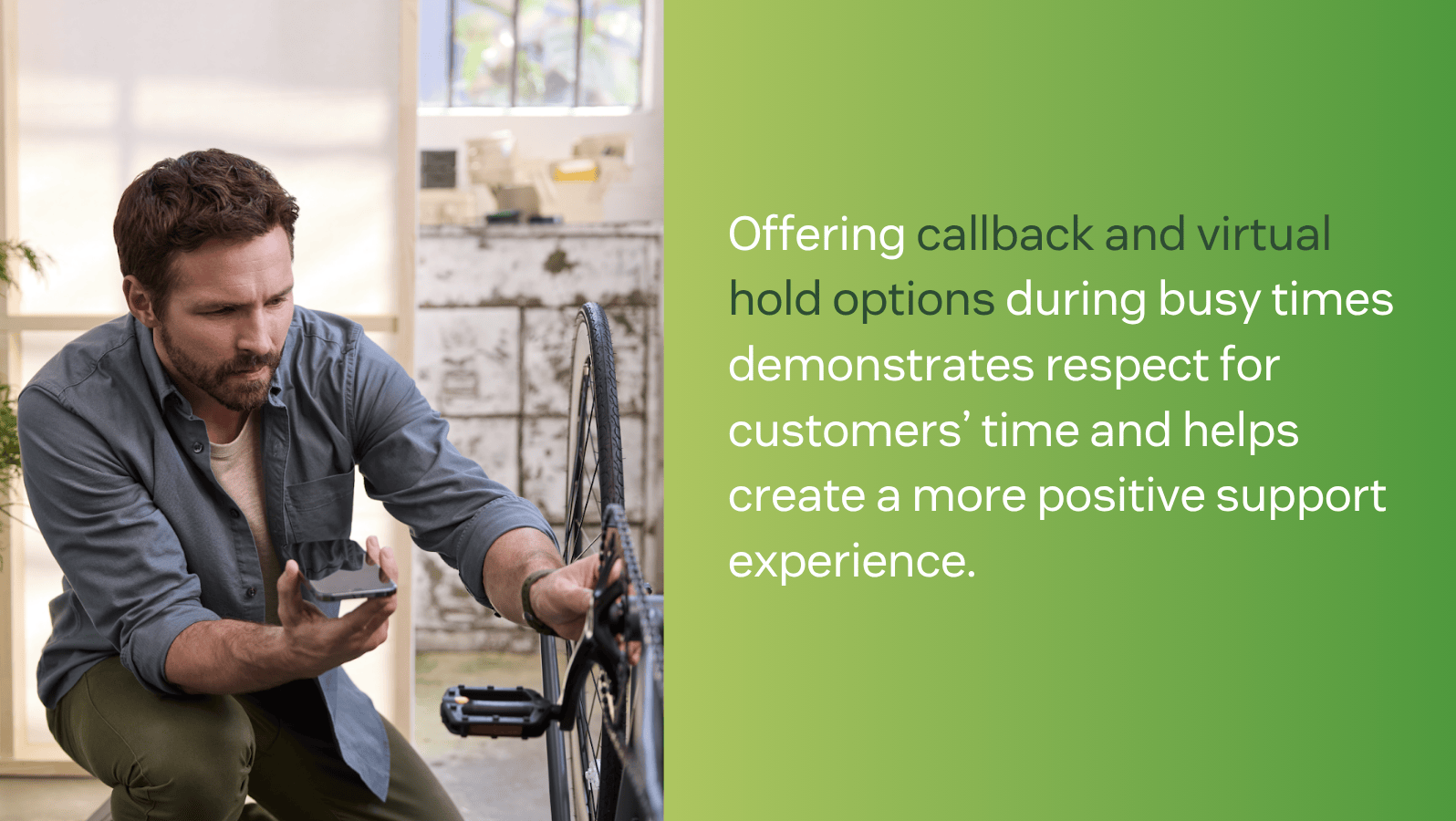
This way, instead of hearing an annoying recording and being kept from moving on with their lives, customers can just wait to be contacted when their time on the line comes. This shows respect for customers’ time and creates a more positive, less stressful support experience.
Train call center agents in empathy and soft skills
Teaching agents how to be empathetic, active listeners, and problem-solvers ensures that when customers reach out to them, they’ll receive thoughtful and compassionate support.
AI agents are designed to have these soft skills and can solve even sophisticated interactions. Solutions like Zendesk’s AI agents can assist with routine issues or gather context before handing off to a human, making it easier for your team to step in with the same care and professionalism.
Recognize and reward high-performing agents
Your agents are the voice of your brand. When they feel valued and rewarded, they keep motivated to do their best. Motivated agents provide better service, which leads to happy customers.
It’s simple—appreciation leads to great employee experience which leads to great customer experience. If you want the voice of your company to sound happy and supportive, invest in incentives, performance tracking, and regular appreciation programs to motivate agents. The high-quality service they deliver directly impacts your contact center CSAT.
Enable self-service options to reduce unnecessary calls
Picture the scenario: Sarah runs a small e-commerce business and uses Zendesk to manage her customer support. She uses Zendesk Voice and wants to set up callback options.
Instead of calling Zendesk support, Sarah tries some self-service options. She finds an article on enabling customer callback in Zendesk’s help center. Then, she follows the step-by-step instructions. She also learns how to customize callback messages from a comment in the community discussion thread, and asks Zendesk’s AI agent about enabling callback during business hours.
In less than 10 minutes, Sarah figured callback all by herself and successfully set up the feature without ever calling support.
Sarah is happy she quickly found the answers she needed. Zendesk is happy its support isn’t loaded with minor issues that don’t need thorough phone assistance. Everybody wins.
Collect and act on customer feedback across channels
CSAT isn’t the only way to measure customer satisfaction. To capture a full view of the customer experience, you should combine other call center metrics, including Net Promoter Score (NPS) and Customer Effort Score (CES).
These are useful for collecting customer feedback, understanding loyalty, and analyzing ease of interaction across other channels besides calls (chats and emails, for example).
Improve workforce management and scheduling in the call center
Your team’s availability directly impacts customer satisfaction, as having fewer agents available causes longer wait times. Workforce management tools can help you forecast call volumes. This allows you to schedule agents efficiently and ensure the appropriate amount of staffing at all times.
Aligning staffing with call volumes not only reduces wait times, but also prevents agents from burning out, enhancing the experience for both customers and agents.
Leverage analytics to identify CSAT trends and root causes
Deep analysis of CSAT trends and root causes can also help you boost call center customer satisfaction. Dashboards can provide data-rich reports with essential insights to track satisfaction drivers.
Gaining a better understanding of what drives customer satisfaction and which specific improvements are needed empowers your call center team to make data-informed decisions that elevate the customer experience.
Continuously review and optimize call center processes
Call center processes should evolve alongside customers’ needs and expectations. Remember to regularly update scripts, workflows, and escalation paths to ensure they’re still aligned with current business goals and customer feedback.
You can turn to a QA software for customer service to find insights from reviews, analytics, and survey results. Continuous optimization keeps satisfaction levels high over time.
4 common challenges in improving call center CSAT
From disconnected data to outdated tools, there are many challenges you may face when trying to improve call center CSAT levels. Recognizing these issues is the first step to delivering better service. We’ve listed the 5 most important ones to keep in mind.
Data silos create fragmented experiences
Customers get frustrated when agents don’t have a full picture of their history. This happens when companies create data silos, information that’s stored in various places and isolated.
When customers’ information is siloed, agents have to switch systems, ask customers to repeat themselves, or accept that specific data can’t be accessed. So, if agents don’t have all the information they need to interact with a customer, providing a positive experience may be more challenging.
If your company relies on data silos, consider finding a solution that centralizes customer data in one workspace—like Zendesk—to create a faster and more personalized service.
Inaccurate or incomplete metrics mislead decisions
You may also face challenges improving your contact center CSAT if your metrics are inaccurate or incomplete. How can your agents know where to improve if you don’t provide them with the right metrics?
To overcome this, make sure you lean on a solution that provides reliable QA and thorough analytics. By using AI-powered quality assurance, you can boost CSAT by 2.5% with AutoQA. The tool scores the quality of all interactions to deliver accurate performance trends and continuously improve customer satisfaction.
High agent turnover impacts consistency
Call center burnout is unfortunately a huge and incredibly common problem. It can lead to high agent turnover, dramatically impacting consistency—new hires take time to train and high attrition drives up costs and lowers morale.
Even though it’s quite common, call center burnout doesn’t have to be a problem your company faces. Recognizing when agents are burning out is the first step. Then, look for more effective agent tools, streamline workflows, and invest in better call center technology.
Outdated tools lower call center satisfaction
You may have no idea, but your legacy system might be what’s keeping you from enhancing customer experiences. Outdated tools that don’t integrate across channels make agents waste time switching between platforms to find the right information. The consequences are longer handling times and more mistakes. Also, without automation, agents waste time performing repetitive tasks that could be easily streamlined.
Modern customer service platforms help teams overcome these issues by integrating channels, automating routine processes, and providing real-time insights. Plus, they’re easier to scale as demand grows. Relying on a useful tool like Zendesk’s cuts down resolution times and empowers agents to focus on what really matters: delivering exceptional support.
Customer story
“Now our agents can see who is calling and personalize the call. It not only saves time for everyone, but It’s really lovely to hear customers’ positive reactions: “Oh, you know who I am!”
—Voice of Customer Manager at The Coffee Club
Increase call center customer satisfaction with Zendesk
Even in today’s digital-first world, the phone remains a highly trusted support channel. That means your call center plays a critical role in shaping every customer’s perception of your brand.
To keep customers happy and loyal, you need to continuously refine your processes, empower your agents, and adopt the right tools to raise call center customer satisfaction and deliver experiences that exceed expectations.